
Gregory and Lucy Leu recently visited the Yokayo Ranch, in Ukiah, California. This place has a significant place in the birth of Insight Dialogue: Gregory recalls coming up with the name “Insight Dialogue” on the way to teach this retreat in the fall of 1994, and the first ever Insight Dialogue retreat was offered there. And coming out of that retreat was the first online chat-only ID practice group which opened the door to the forms of Insight Dialogue practice and the community as we know it today.
Recently, Gen Heng (an ID facilitator based in Hong Kong) and Gregory had a chance to chat about his visit to this special place.
Gen:
Gregory, thank you for taking the time to share about this trip that you recently made to Yokayo Ranch. Could you tell us about the significance of this place for you and for Insight Dialogue?
Gregory:
The Yokayo ranch was a Metta foundation investment in Ukiah, in northern California. And it was on the main ranch house of the property where we did the first Insight Dialogue retreat ever.
I had been exploring a dialogic practice in my Ph.D. program with another member of my cohort, Terri O’Fallon. The faintest sense of a mindful dialogue practice was emerging, but the name itself, Insight Dialogue, only came to me as I was flying out to California to teach this small vipassana retreat.
So the place has multiple layers of significance. From that retreat grew also the online practice group that for 2 years afterwards was the only form that Insight Dialogue had.
So what was it like being back at the house?
Gregory:
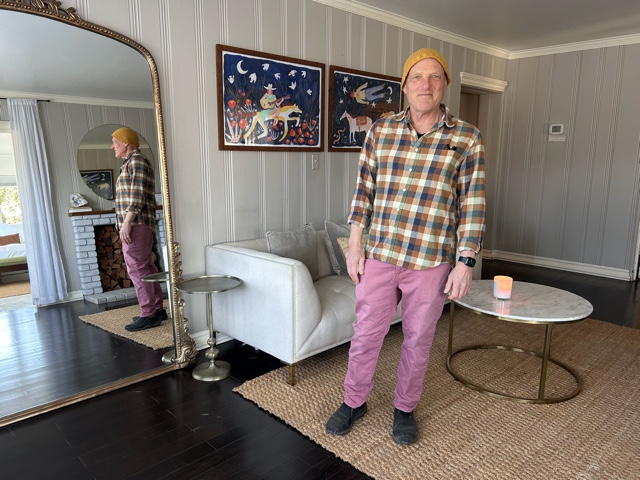
I had to go to Ukiah for some Metta Foundation work, so while I was there I thought that I’d go look at the old house and walk around. It was fun. It had been fixed up by its new owners and I was given free rein to walk around. Unexpectedly, I found myself stopping in surprise as I looked at this room and it’s like, “Wow! This is where the first Insight Dialogue retreat took place. This is where the practice first had a name.”
How did that first retreat come together?
Gregory:
At that time I was teaching Vipassana, traditional silent meditation. A number of my students wanted to have a retreat, so I agreed to teach one. And Metta Foundation could supply this unoccupied house for free. I didn’t plan on offering this dialogue as a big part of the retreat, although I’d guess we planned on trying the practice together while in Ukiah.
Because I’d been teaching meditation to Terri at the same time that she and I were both exploring dialogue in our Ph.D. program, we both naturally brought the meditation practice into our dialogue. Basically, we followed this thread of mindfulness in dialogue not as a plan, but as an emergent potential. We commented on that together and began to do it intentionally. We could feel that something was going on here, something was bubbling, but it was in no way ready for a full-on retreat.
It was a very small retreat, I think there were 5 or 6 of us. It was an insight meditation retreat, with silent practice from early morning. Each afternoon I made space for dialogue practice. It felt risky to me as I wanted to respect everyone’s wish for a productive meditation retreat.
So what was Insight Dialogue practice like at that retreat? Would we recognise it as the same Insight Dialogue we know today?
Gregory:
At that first retreat, I introduced some guidelines that Terri and I had been playing with. I don’t remember them all,, but they were very general like “commit to the process” and “share parallel thinking.” Nothing like what you know of Insight Dialogue today. Not even the pause, none of that. It was really just to pay attention to what’s emergent in what David Bohm called shared consciousness.
We were combining that open group dialogue with mindfulness meditation. There were no subgroups, no contemplations. Just a bell, then open the space to whomever in the whole group was moved to speak. As each person spoke, we continued our mindfulness practice. Simple. We would do that each afternoon for probably about an hour and a half and then go back into silence.
After about 4 or 5 days, out of respect for the power of traditional, silent retreat, and wanting the retreat participants to gain whatever they could from silent immersion, I stopped the dialogue practice. I didn’t know where ID was going to go, so I couldn’t yet trust where the total practice, silent and in dialogue, would leave them.
How was the experience of offering Insight Dialogue for you or for the retreatants that first time?
Gregory:
I can speak from my own experience, and I believe that this was the case for the others as well, that there was surprisingly little disruption from the dialogue to the development of steadiness and mindfulness of our silent practice. That had been a big concern of mine, so I was surprised and really pleased. I was encouraged. I can’t say that it did or didn’t have any big impact on people. Not that I recall, honestly. But just the fact that it was not disruptive seemed pretty big to me at that time.
And what happened after the retreat?
Gregory:
There were five of us on that retreat: Terri, with whom I was partnering in the PhD work; Gary Steinberg, who later became an ID teacher, Polly Van Hall, who worked at the Newark Airport fuel transfer station; and Ken Rupp, a well-known jazz trombonist. All of us except Ken continued on in an online ID group. We would meet in AOL chat rooms and practice Insight Dialogue via text.
We found that if you bring sati and samādhi to almost anything, something’s going to happen, right? And that’s what we discovered!
As I listen to the development of Insight Dialogue, of your journey with Terri and the others, it doesn’t sound like you were thinking, “How do I do create a practice of right speech or mindfulness in daily life?”. Instead, it sounded like two friends working on something together, with shared interests and intentions, and from that something unfolded…
Gregory:
Yeah, it is much more like that. I would say that one of the really sweet things about the partnership that Terri and I had was that we were both really intense. So once we started working on this, our keen focus let us a sense, through these AOL chat rooms, how the mind could really come into just a simple line of text, and then pause, reread and immerse in it. And then feel the fingers typing. Moment by moment sati, mindfulness practice.
And the sense of doing this meditation with others, just through the language, was fresh. Even though we knew language was conceptual and empty, there was life in these practice sessions. It was really quite something.
There was a spark of practice that we felt we were looking after. The fact that it came just from the simple seed of bringing the meditative quality of mindfulness, together with something of the power of relationship, through text – Wow!
Following the close of our Ph.D work, I began to share ID in small practice groups in Portland, OR. It took years for the guidelines to come to life. And the first Insight Dialogue retreat for the public was at Barre, Massachusetts in 1999, and even in that retreat, it was without the current guidelines, and all one large practice group, with 30 people speaking into the circle. From there, I began teaching other retreats and the form of ID continued to evolve. The form of the guidelines as you know them began to emerge, I started to introduce subgroups and contemplations drawn from the Dhamma.
So even though you’ve pointed out that we wouldn’t recognise the practice back then as the Insight Dialogue of today, the seeds were there.
Gregory:
For sure., What you would recognise, if you were looking over at my shoulder as I stared at AOL chat text, was that I was focused and attentive. There was some peacefulness, but I would say the energy factor was stronger than the tranquility factor. The quality of investigation was quite strong. And when someone replied in text, you would get a sense that there’s other people there, immersed with you in this inquiry.
In my heart and mind, there was that mindfulness in relationship, then and now.
What would you say to yourself back then, from where you are today?
Gregory:
I’d suggest, “Be patient. Trust that this will find its way.”
I had the natural tendency to persevere, but behind it was some impatience with how things were evolving. I wanted to share something that I thought was really beautiful and for a long time it felt like I was crying in the wilderness. My zeal was mixed with desire, with impatience. So even as I felt wonder and gratitude, I also experienced unnecessary suffering. So I’d say something just to bring that more intense young Gregory a little bit of peace and happiness.
There was some audacity in naming this thing “Insight Dialogue.” The word “insight” – I’m a pretty conservative guy and I really respect that word. And I meant it when I called this an insight practice. So there was a kind of trust in its efficacy that I didn’t yet really understand.
I’d want that Greg of the early days to be inspired by the qualities of awareness, of non-personalised Metta and compassion, and the joy that it’s brought to people.
Is there anything else about that first retreat, or what was born from that, that you’d like to share?
I feel a lot of gratitude to my partners in the work, especially the early core group of Terri, Gary, and Polly. Without their intense commitment, it wouldn’t have been the seedbed that it was. Imagine, four people meeting every single week for two years to stare at text on a screen. But those hours of practice gave me a sense that this is something I’m really moved to commit myself to going forward. Their full involvement was crucial to that.
That was the start of this long road.
And here we are, 31 years later. I really sense the benefits of all the seeds that were planted and the people who were involved. I have just such gratitude for you all, and this place I’ve never been to.
Thank you so much, Greg.
For more Insight Dialogue history, here’s a conversation between Gregory Kramer and Terri O’Fallon in 2017 about their work together.